SPR AUTO TECHNOLOGIES LTD
12 Jun 2026 ·
The Last Man Standing — and What That Is Worth
| Rating | CMP | 12M Target | 12M Upside | Horizon View |
| Hold | ₹3,416 | ₹3,666 | 7% | Re-Rating is FY28+ |
I. Executive Summary
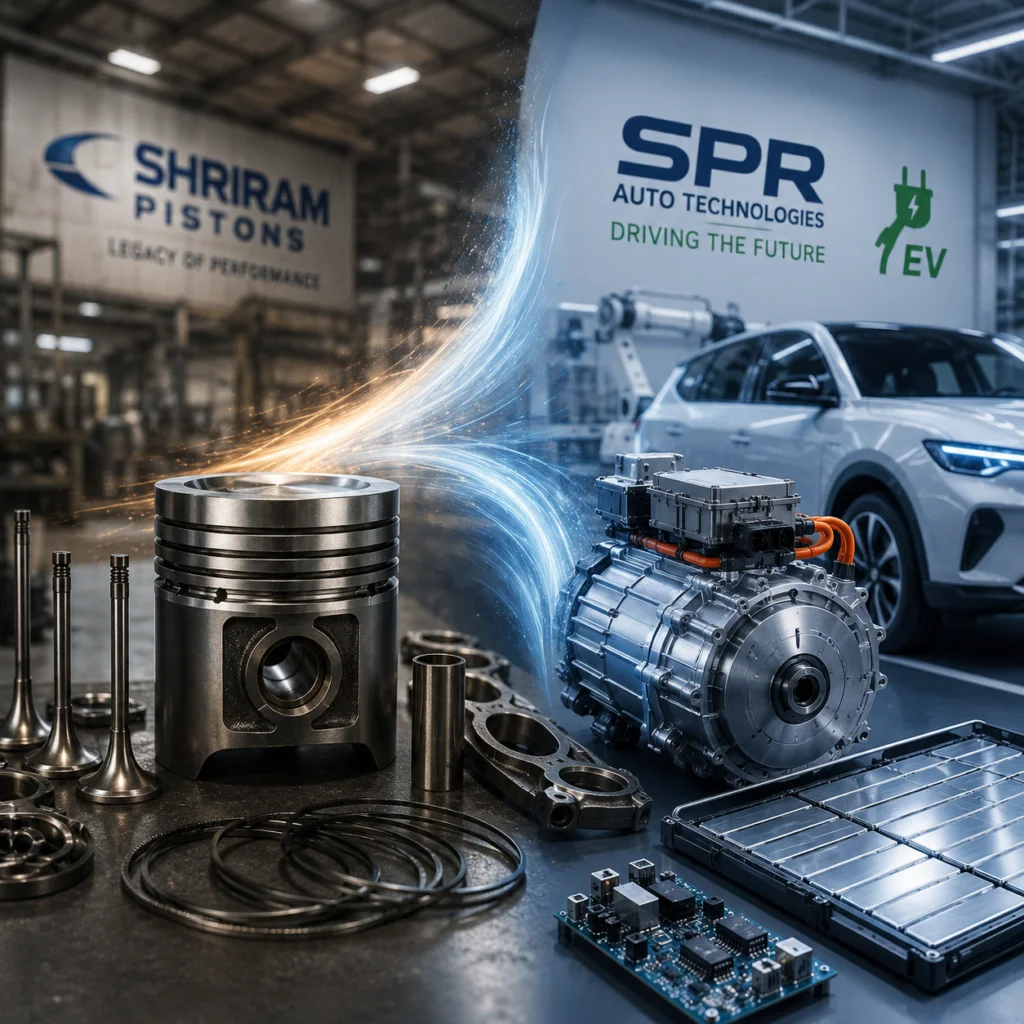
SPR Auto Technologies is a leading automotive technology company that has evolved from a traditional piston manufacturer into a diversified auto-component platform with exposure across engine components, precision plastics, EV powertrain systems, and vehicle interiors. While the company’s legacy business continues to manufacture critical engine components such as pistons, rings, pins, and valves, management believes the segment remains structurally attractive due to hybrid vehicle growth, stricter emission norms, increasing content per engine, and market-share gains arising from global competitors exiting the industry. This core business continues to generate strong cash flows, maintain industry-leading profitability, and serves as the financial foundation for the group’s expansion strategy.
Over the last six years, the company has executed a deliberate diversification strategy through acquisitions including Takahata, TGPEL, EMFI, Antolin, and Karna Intertech. These investments have expanded SPR’s presence into precision plastics, EV motors and controllers, and automotive interiors and lighting, reducing dependence on traditional internal combustion engine components. Following the Antolin acquisition, powertrain-agnostic businesses account for approximately 35% of consolidated revenue, while nearly 60% of the overall business is no longer directly exposed to powertrain technology. The company’s long-term growth strategy is centred around acquiring technology-led businesses, improving their profitability through operational efficiencies and synergies, and creating a diversified automotive technology platform capable of delivering sustainable growth across industry cycles.
We initiate coverage with an ACCUMULATE / HOLD rating. While SPR possesses a high-quality business model, strong management execution, and a credible track record of value-accretive acquisitions, the stock appears broadly fairly valued on a 12-month basis with limited near-term upside. The larger investment opportunity lies in FY28–FY30, where successful integration of Antolin, margin convergence across acquired businesses, continued diversification, and disciplined capital allocation could drive a meaningful re-rating. Investors should view SPR as a long-term compounder transitioning from a piston-centric business to a multi-product automotive technology platform and consider accumulating the stock on periods of market weakness.
II. Business Model At Glance
1. Legacy Powertrain Business (Core Engine Components)

Think of SPR as the company that makes the small, super-precise metal parts that live inside an engine — pistons, piston rings, piston pins, crank pins and engine valves. These are the parts that move up and down (or open and shut) thousands of times a minute, surviving extreme heat and pressure. A piston looks simple but is machined to a few microns of accuracy, expands when hot and has to return to its exact shape when it cools. That difficulty is the moat.
SPR doesn’t simply sell a piston off the shelf. It co-designs each component with the vehicle manufacturer because every engine is different. Once SPR’s piston is approved and designed into an engine platform, replacing it becomes difficult because qualifying a new supplier takes time, testing and risk. This creates long-term customer stickiness. The company serves both OEM customers such as Maruti, Tata, Mahindra, Jaguar Land Rover and Caterpillar, as well as the aftermarket where replacement pistons are required during engine rebuilding. Exports contribute around 18–20% of standalone revenue and are spread across more than 45 countries, reducing dependence on any single market.
Despite concerns around electric vehicles, management repeatedly emphasizes that this business is not disappearing. Pistons remain essential in petrol, diesel, CNG, LNG, biofuel and hybrid engines. As several global competitors reduce capacity due to EV concerns, SPR is gaining market share and pricing power. At the same time, tighter emission norms such as Euro 6 and Euro 7 require advanced coatings, hard anodizing and lighter designs, increasing the value of each piston sold. As a result, the legacy business continues to grow around 10–11%, faster than the underlying engine market.
2. Precision Plastics Business

Through its Takahata and TGPEL subsidiaries, SPR manufactures highly engineered plastic components used in steering systems, braking systems, seatbelts, headlamp adjusters and anti-skid braking systems (ABS). These are not low-value plastic parts but precision-engineered components that require tight tolerances and high reliability.
The company deliberately avoids commodity plastic products where competition is intense and margins are low. Instead, it focuses on niche applications where quality and engineering matter more than price. This allows the business to maintain EBITDA margins close to 20%. The increasing adoption of safety systems, particularly mandatory ABS in two-wheelers, is creating a favorable demand environment for this segment.
3. EV Motors & Controllers Busines

SPR entered the electric mobility ecosystem through EMFI and its newly established Coimbatore facility. The business manufactures electric motors ranging from 1.5 kW for small electric scooters to 300 kW motors used in buses, trucks and mining equipment.
One of SPR’s differentiators is that it develops both the motor and controller together and validates them as a complete system. For customers, this reduces integration challenges and improves reliability. The company is also developing ferrite-based rare-earth-free motors to reduce dependence on Chinese rare-earth magnets and improve supply chain security.
Although this segment is currently small relative to the group’s total revenue, it is scaling rapidly and has reported growth rates of 5–7 times from a small base. Management views this business as an important future growth engine within the broader electrification trend.
4. Automotive Interiors & Lighting Business

The biggest diversification step came through the acquisition of Antolin’s Indian operations in January 2026 for approximately €159 million (around ₹1,670 crore). Through this acquisition, SPR entered the automotive interiors and lighting segment.
The business manufactures headliners (roof linings), door panels, trims, sun visors, ambient lighting systems and touch panels supplied to virtually every major passenger vehicle manufacturer in India. Unlike pistons, these products are completely independent of the vehicle’s powertrain. Whether a car runs on petrol, diesel, hybrid or electricity, it still requires interior and lighting components.
This acquisition significantly broadens SPR’s addressable market and reduces dependence on engine-related products. It also represents the largest contributor to the company’s “powertrain-agnostic” strategy.
5. Acquisition & Integration Platform (The Hidden Business Model)
The real growth engine behind SPR is not just pistons, plastics, motors or interiors. It is the company’s ability to acquire technology-led businesses and improve their profitability over time.
Management follows a repeatable acquire-and-improve playbook. Businesses are acquired with strong technology, customer relationships or market positions, and then SPR applies operational efficiencies, sourcing benefits, manufacturing improvements and scale advantages to raise margins. The objective is to bring acquired businesses closer to SPR’s own profitability levels, which are around 20% EBITDA margins.
The Antolin acquisition is a good example. The acquired business entered the group with EBITDA margins of approximately 9–10%. Management’s goal is to gradually improve these margins over the next few years through synergies and operational improvements. If successful, earnings growth could significantly outpace revenue growth.
6. Revenue Mix After Antolin Acquisition
| Segment | Revenue Share |
|---|---|
| Legacy Powertrain (Pistons, Rings, Valves, Pins) | ~65% |
| Precision Plastics + Interiors & Lighting + EV Motors | ~35% |
Looking at the company another way, approximately 60% of the overall business is now insulated from the ICE-versus-EV debate because it either serves all vehicle types or participates directly in EVs. Legacy powertrain remains the primary cash-generating engine, while the newer businesses are becoming the primary growth drivers.
With FY26 consolidated revenue of approximately ₹4,571 crore, SPR has evolved from a piston manufacturer into a diversified automotive technology platform spanning powertrain components, precision plastics, electric mobility systems, automotive interiors and lighting solutions.
III. FINANCIAL STATEMENT ANALYSIS
1. Income Statement: Sustained Double-Digit Growth with Margin Resilience

SPR Auto Technologies delivered its strongest financial performance to date in FY26, reporting consolidated total income of ₹4,571 crore, representing 25% YoY growth. Growth was supported by a combination of robust organic demand recovery during the second half of the year and the contribution from recently acquired businesses, particularly Antolin India.
Consolidated EBITDA reached a record ₹989 crore, growing approximately 18% YoY. Despite commodity volatility and integration of lower-margin acquired entities, the standalone business maintained EBITDA margins above 20%, highlighting the strength of the core powertrain franchise.
Reported profitability was impacted by a one-time exceptional charge of ₹25.2 crore related to the implementation of India’s new Labour Codes in November 2025. Excluding this non-recurring item, profit before tax grew approximately 22% YoY, indicating that underlying earnings momentum remained healthy.
A temporary decline in standalone gross margins from approximately 61% to 58% was driven primarily by product mix changes, including a higher contribution from small-car platforms and GST-related timing effects. Management has explicitly stated that the margin movement was not due to pricing pressure or market share losses, maintaining that the company did not lose even 1% market share during the period.
Key Income Statement Metrics
| Metric | FY26 |
|---|---|
| Revenue Growth | 25% YoY |
| EBITDA Margin | ~20–22% |
| Standalone Gross Margin | ~58% |
| Net Margin (TTM) | 12.4% |
| Exceptional Charge | ₹25.2 crore |
The ability to sustain industry-leading margins while integrating acquired businesses demonstrates the underlying strength of SPR’s operating model and pricing discipline.
2. Balance Sheet & Cash Flow Analysis
Conservative Leverage Despite Major Acquisition

Following the Antolin acquisition, net debt increased to approximately ₹933 crore. However, leverage remains comfortable at roughly 0.25x equity, leaving significant capacity for future acquisitions.
Management continues to describe the balance sheet as under-leveraged, with the recently raised ₹1,000 crore Non-Convertible Debentures (NCDs) intended primarily to fund acquisitions rather than support existing operations.
Strong Self-Funding Capability
One of SPR’s key strengths is the separation between organic and inorganic capital allocation.
Operating cash flows are sufficient to fund:
- Annual organic capex of approximately ₹200 crore
- Regular dividend payouts of ₹10 per share
- Working capital requirements
As a result, external capital is largely reserved for strategic acquisitions rather than supporting day-to-day operations.
Stable Working Capital Structure
Working capital requirements have historically remained within a disciplined range despite fluctuations in aluminium prices.
The company’s LME-linked pricing contracts allow raw material inflation to be passed through to customers with roughly a one-quarter lag, limiting long-term margin and cash flow risk.
3. Return on Invested Capital (ROIC): The Most Important Metric
SPR’s ROIC journey highlights the transformation of the business over the last several years.
| FY | ROIC |
|---|---|
| FY20 | 6.9% |
| FY21 | 7.6% |
| FY22 | 12.2% |
| FY23 | 16.6% |
| FY24 | 19.1% |
| FY25 | 18.7% |
| FY26 | 12.5% |
Between FY20 and FY25, the company successfully transformed itself from a relatively low-return component manufacturer into a high-teens return franchise through market share gains, operational efficiencies and diversification.
The apparent decline in FY26 ROIC to 12.5% requires careful interpretation.
Invested capital increased sharply from ₹2,901 crore to ₹4,870 crore following the Antolin acquisition, a 68% increase in the capital base. Meanwhile, NOPAT continued to grow from ₹542 crore to ₹608 crore. The decline in ROIC therefore reflects the immediate addition of acquisition capital before a full year of earnings contribution from the acquired business.
This is primarily a timing issue rather than a deterioration in operating performance.
4. Marginal Returns Analysis
Understanding the Antolin Effect
| Metric | FY22 | FY23 | FY24 | FY25 | FY26 |
|---|---|---|---|---|---|
| Marginal ROIC | 63.2% | 30.4% | 27.7% | 16.4% | 3.4% |
| Marginal Operating Margin | 19.0% | 28.6% | 37.9% | 17.8% | 16.7% |
During FY22-FY25, SPR generated exceptionally strong incremental returns, reflecting successful market share gains and efficient capital deployment.
The sharp decline in marginal ROIC to 3.4% in FY26 is the central debate surrounding the investment case.
Bears view the figure as evidence of declining returns and increasing capital intensity.
Bulls argue that the number simply reflects the upfront capital invested in Antolin before the acquired business has had sufficient time to contribute earnings. Since only a partial year of Antolin earnings was recognized in FY26, the acquired capital is fully reflected while the earnings contribution remains incomplete.
5. Investment Interpretation
The key question for investors is not whether FY26 returns declined—they clearly did. The more important question is whether management can successfully execute its integration strategy and improve Antolin’s profitability over the next two to three years.
Historically, SPR has demonstrated an ability to acquire technology-focused businesses and gradually improve their margins through operational efficiencies and scale benefits. If Antolin’s margins converge toward group averages, consolidated ROIC could recover toward the high-teens level over time.
Therefore, the investment thesis increasingly rests on management’s ability to transform Antolin from a lower-return acquired asset into a higher-return component of the group. Successful execution would support both earnings growth and valuation expansion, while failure to improve returns would likely result in SPR being valued as a more conventional mid-teens growth automotive supplier.
IV. Variant Perception Framework
1. What the Market Thinks
The investment debate around SPR largely revolves around three concerns.
First, many investors believe the core piston business will gradually decline as electric vehicles gain market share. Second, some investors assume the company’s recent 20–25% growth rate is fully organic and sustainable over the long term. Third, the decline in FY26 ROIC and the lower profitability of the Antolin acquisition have raised concerns about margin dilution and weakening returns.
2. Our View
We believe both the bullish and bearish views are too extreme.
The legacy piston business remains stronger than commonly perceived. SPR benefits from deep customer relationships, high engineering complexity, aftermarket leadership and a shrinking competitive landscape as several global competitors reduce capacity. This should allow the core business to continue growing faster than the underlying automotive market.
At the same time, investors should recognize that not all of the recent growth is organic. Without acquisitions, consolidated growth is likely to be in the low-to-mid teens. Therefore, the investment case depends not only on business performance but also on management’s ability to identify, acquire and improve attractive businesses.
The decline in returns following the Antolin acquisition should be viewed as a temporary integration effect rather than permanent deterioration. Management has a track record of improving profitability in acquired businesses, and the key question is whether Antolin can follow a similar path over the next few years.
3. Key Drivers of Future Returns
We believe future shareholder returns will depend primarily on:
- Improvement in Antolin’s margins and returns on capital.
- Successful deployment of fresh capital into value-accretive acquisitions.
- Increasing contribution from powertrain-agnostic businesses.
- Continued market share gains in the core powertrain segment.
5. Key Catalysts
| Catalyst | Timeline | Impact |
|---|---|---|
| Antolin margin improvement | FY27–FY29 | High |
| New acquisitions through QIP | FY27 onwards | High |
| Higher powertrain-agnostic revenue mix | FY27–FY28 | Medium |
| Sunbeam piston capacity ramp-up | FY27 | Medium |
| Export demand recovery | FY27–FY28 | Medium |
| NCD repayment and deleveraging | FY27–FY28 | Low |
6. Investment Takeaway
The stock should not be viewed as a pure legacy auto-component company nor as a simple high-growth compounder. The real investment thesis lies in management’s ability to create value through acquisitions and operational improvements. If integration succeeds and acquired businesses move closer to SPR’s profitability levels, earnings growth and valuation multiples can expand together. If execution disappoints, the company is likely to remain a steady mid-teens growth business with limited re-rating potential.
V. Industry Structure & Growth Opportunity
1. Large Market with Long Growth Runway
SPR Auto Technologies operates in the Indian automotive industry, which continues to offer significant long-term growth opportunities. Management estimates that India produces around 3.5 million ICE engines annually and expects overall auto industry volumes to grow at 6–7% CAGR over the next five years.
Despite rising EV adoption, management believes ICE and hybrid vehicles will remain relevant for many years. Even if EV penetration reaches 15–17% by FY31, the absolute number of ICE and hybrid vehicles is expected to continue growing due to India’s low vehicle ownership levels. Only around 4.5–5% of Indian households own a car compared to 30–35% in developed markets.
2. Strong Industry Demand Drivers
Several factors support future growth for SPR:
- Stricter emission norms increase the complexity and value of pistons, rings and valves.
- Growing adoption of hybrid vehicles creates demand for new high-performance engine components.
- The organized aftermarket continues to gain share as customers prefer quality products over low-cost imports.
- Expansion into non-automotive segments such as marine, railways, defence, generators and industrial equipment provides additional growth opportunities.
3. Competitive Advantage from Industry Consolidation
A key industry trend is the gradual exit of several global piston manufacturers due to concerns about EV adoption. This has created a supply gap while demand for ICE and hybrid engines remains healthy.
As competitors reduce capacity, SPR is gaining opportunities to win new customers, increase market share and strengthen its position in global markets. Management aims to benefit from this consolidation and establish itself as a leading long-term supplier of critical engine components.
4. Investment Takeaway
The industry is transitioning toward a multi-powertrain future rather than a pure EV future. With continued demand for ICE and hybrid engines, rising content per vehicle, a growing aftermarket business and favorable industry consolidation, SPR is well positioned to grow faster than the broader automotive market over the coming years.
VII. Forecast & Earnings Drivers
1. Growth Outlook
A key distinction for investors is that SPR’s recent 20%+ growth rate is not entirely organic. The core piston business is expected to grow around 10–11%, while powertrain-agnostic businesses such as Antolin, Takahata and TGPEL could grow 12–15%. EV motors are growing rapidly but from a small base.
As a result, purely organic consolidated growth is likely to be in the low-to-mid teens. Sustaining 20% growth over the long term will require continued acquisitions and successful integration of acquired businesses.
2. Scenario Analysis
| Scenario | Revenue CAGR | FY30 Revenue (₹ Cr) | FY30 Operating Margin | FY30 EPS (₹) |
|---|---|---|---|---|
| Bull Case | 35% | 14,769 | 22.0% | 503 |
| Base Case | 20% | 9,246 | 21.5% | 290 |
| Bear Case | 14% | 7,597 | 17.0% | 173 |
The base case assumes continued acquisitions, steady margin improvement in acquired businesses and successful execution of management’s growth strategy. The bear case assumes no major acquisitions, slower integration and pressure on margins from rising costs.
3. Key Earnings Drivers
- Market share gains in the legacy piston business.
- Growth in automotive interiors, plastics and EV motors.
- New hybrid vehicle programs launching over FY29–FY30.
- Capacity expansion through the Sunbeam piston-line acquisition.
- Margin improvement in acquired businesses, particularly Antolin.
- Operating leverage and synergy benefits from acquisitions
4. Key Upside Risks
- Faster-than-expected improvement in Antolin margins.
- Successful deployment of QIP proceeds into value-accretive acquisitions.
- Recovery in export demand.
- Stronger growth in the EV motor business.
5. Key Downside Risks
- Prolonged rise in aluminium prices impacting margins.
- Delays in integrating acquired businesses.
- Equity dilution without timely deployment of capital.
- Weak demand in export markets
6. Investment Takeaway
The central investment thesis depends on management’s ability to continue acquiring and improving businesses. If execution remains strong, SPR can sustain high growth and improve profitability over time. If acquisitions slow or integration falls short of expectations, growth is likely to normalize closer to the low-to-mid teens.
VIII. Valuation & Scenario Analysis
1. Valuation Approach
We value SPR Auto Technologies using two methodologies: Forward P/E and Forward EV/EBITDA. The final valuation is derived using a probability-weighted framework comprising Bull (30%), Base (50%) and Bear (20%) scenarios.
2. Scenario Assumptions
| Scenario | Revenue CAGR | FY30 Revenue (₹ Cr) | FY30 Operating Margin | FY30 EPS (₹) |
|---|---|---|---|---|
| Bull Case | 35% | 14,769 | 22.0% | 503 |
| Base Case | 20% | 9,246 | 21.5% | 290 |
| Bear Case | 14% | 7,597 | 17.0% | 173 |
3. Probability-Weighted Target Price
| FY | FY27 | FY28 | FY29 | FY30 |
|---|---|---|---|---|
| P/E-Based Target (₹) | 3,743 | 4,967 | 6,899 | 9,574 |
| EV/EBITDA-Based Target (₹) | 3,589 | 4,641 | 6,102 | 8,135 |
| Average Target Price (₹) | 3,666 | 4,804 | 6,501 | 8,855 |
| Upside vs CMP (₹3,416) | 7% | 41% | 90% | 159% |
4. Investment View
At the current market price of ₹3,416, the stock appears broadly fairly valued on a 12-month basis, offering limited near-term upside. However, the medium-term opportunity remains attractive if management successfully executes its acquisition and integration strategy.
The key investment appeal lies in the FY28–FY30 period, where earnings growth, margin expansion and improving returns on capital could drive significant value creation.
5. Key Valuation Drivers
| Driver | Impact on Valuation |
|---|---|
| Antolin Margin Improvement | High |
| Successful QIP Deployment & M&A | High |
| Increase in Powertrain-Agnostic Revenue Mix | High |
| ROIC Recovery Towards High-Teens | High |
| Export Demand Recovery | Medium |
| Aluminium Price Volatility | Medium |
| QIP Dilution Without Deployment | Negative |
6. Investment Takeaway
SPR is increasingly transitioning from a traditional piston manufacturer into a diversified automotive technology platform. The market currently values the company between these two identities. Future upside will largely depend on management’s ability to improve Antolin’s profitability, maintain acquisition discipline and increase the contribution of powertrain-agnostic businesses.
Recommendation: ACCUMULATE / HOLD
The stock appears fairly valued in the near term but offers attractive long-term compounding potential if management successfully delivers on margin convergence, capital allocation and growth execution over FY27–FY30.
IX. Risks & Alpha Dashboard
1. Key Investment Risks
| Risk | Impact |
|---|---|
| Antolin Integration Risk | Failure to improve margins could keep ROIC and profitability depressed. |
| M&A Execution Risk | Future growth depends on successful acquisitions and capital deployment. |
| Commodity Price Risk | Rising aluminium prices can temporarily pressure margins due to pass-through lag. |
| Export Demand Risk | Weakness in Europe and Middle East markets could impact growth. |
| Faster EV Adoption | Accelerated EV transition may reduce long-term demand for legacy powertrain products. |
| QIP Dilution Risk | Equity dilution without value-accretive deployment could impact shareholder returns. |
2. Alpha Dashboard
| Metric | Current | Bull Signal | Bear Signal |
|---|---|---|---|
| Consolidated Operating Margin | ~20–22% | Above 22% | Below 19% |
| Antolin EBITDA Margin | ~9–10% | Moving toward mid-teens | Remains below 10% |
| Consolidated ROIC | 12.5% | Above 15% | Stuck near 12% |
| Powertrain-Agnostic Revenue Mix | ~35% | Above 40% | Flat or declining |
| Legacy Growth vs Industry | ~2–3x | Sustained outperformance | Converges with industry |
| Net Debt / Equity | ~0.25x | Growth with stable leverage | Rising leverage without growth |
| Export Growth | Flat | Strong recovery | Continued decline |
| EMFI Growth | Rapid growth | ₹100 Cr+ run rate | Growth slowdown |
3. Quarterly Monitoring Checklist
Investors should closely monitor:
- Antolin revenue growth and margin improvement.
- Consolidated ROIC recovery trajectory.
- Powertrain-agnostic revenue contribution.
- QIP deployment and acquisition execution.
- Aluminium price movements and margin impact.
- Export demand recovery.
- EMFI scaling and profitability progress.
4. Key Investment Question
The investment thesis ultimately depends on whether management can successfully improve the profitability of acquired businesses, particularly Antolin. If margin convergence and ROIC recovery materialize, SPR could be re-rated as a diversified auto-technology platform. If integration disappoints, the stock is likely to remain valued as a traditional auto-component manufacturer.
5. Investment Takeaway
Near-term upside appears limited, but successful execution over the next two to three years could unlock meaningful earnings growth and valuation expansion. The most important indicators to track are Antolin margins, consolidated ROIC and management’s capital allocation decisions.
X. Disclosures & Disclaimer
This report has been prepared solely for educational and research purposes and should not be construed as investment advice, a recommendation, or an offer to buy or sell any security. Investors should conduct their own due diligence and consult a qualified financial adviser before making investment decisions.
The analysis is based on publicly available information, including company filings, investor presentations, earnings call transcripts, annual reports and other corporate disclosures. While reasonable efforts have been made to ensure accuracy, no representation or warranty is made regarding the completeness or reliability of the information presented.
All forecasts, estimates, scenario analyses and valuation assumptions are based on analyst judgement and are inherently subject to uncertainty. Actual results may differ materially from those projected due to changes in market conditions, industry dynamics, company performance, regulatory developments or other unforeseen factors.
The valuation framework, probability-weighted scenarios and future growth assumptions represent analytical opinions at the time of writing and should not be interpreted as guarantees of future performance.
Investing in equities involves risks, including the possible loss of capital. Past performance is not indicative of future results.
Company Note: During FY26, Shriram Pistons & Rings Limited was renamed SPR Auto Technologies Limited, reflecting its transition from a traditional piston manufacturer to a diversified automotive technology platform. The stock exchange ticker SHRIPISTON remained unchanged at the time of this report.